
A reliable method
Use the same endpoint order in both differences. Substitute a known point into y=mx+c to find c. For perpendicular nonvertical lines, use gradients whose product is −1.
The common trap
A coordinate is not a distance. A vertical line has no finite gradient and cannot be handled by dividing by zero.
Make the connection
Plot two verified points and compare the resulting line with its equation. Keep a ruler and an appropriate scale for written graph questions.
A line must match both gradient and position
Through A(1,2) and B(3,8), the rise is six and the run is two, so the gradient is three. Using rise alone would give six; reversing only one subtraction would give negative three. Substitution into y=3x+c gives c=−1. A perpendicular line has gradient −1/3, but its intercept still depends on the point it passes through. The midpoint is (2,5), which satisfies the original line. Coordinate averaging and gradient subtraction answer different questions, even though both use the same two given points.
Transfer, explain and check
Find the perpendicular through the midpoint: y=−x/3+17/3. Check x=2 gives y=5 and the gradients multiply to −1. Explain why a line with the same gradient but another intercept is not this bisector.
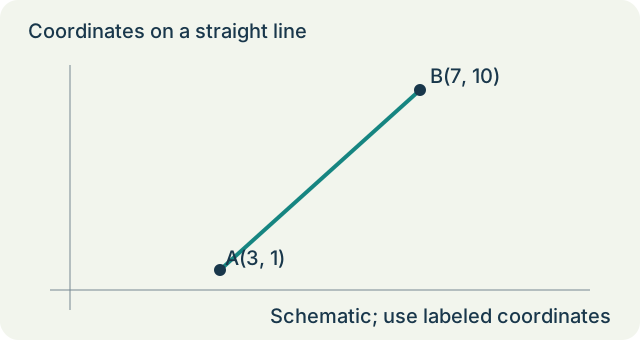
Use the coordinates labeled on the diagram. What is the gradient of AB?
 Open full-size diagram ↗
- Subtract y-coordinates and x-coordinates in the same order.
- The rise is 9 and the run is 4.
- Divide rise by run.
Compare the other answer choices
Invert rise and run.
Reverse only one coordinate subtraction.
Divide sums of coordinates instead of differences.
Try it, then explain it.
Complete a short set without looking at the example. After each answer, explain which operation preserved the relationship and why the result makes sense.
Sources & authorship
Original Slope explanations and examples. References support the concepts; they are not the source of copied questions. Independent educator review is pending.
Cambridge IGCSE Mathematics 0580