
Reviewed captions build repeated-percent growth and decay models from a starting amount, a factor and elapsed periods.
Name what repeats
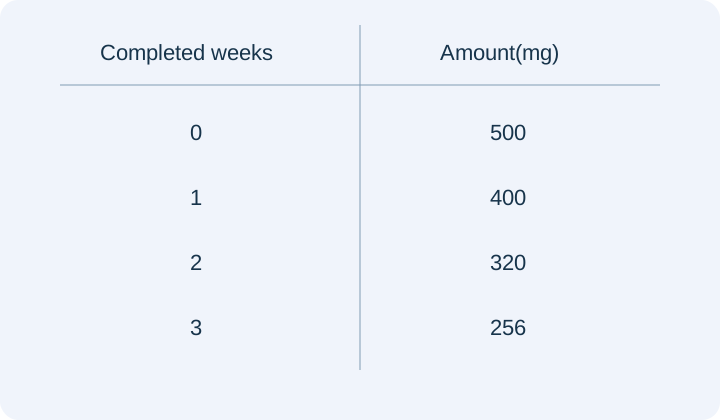
A quantity changing by a fixed percentage uses the current amount as its base each period. Imagine a water-treatment model starts with 500 milligrams of a dissolved substance and removes 20% of the amount present at the beginning of each weekly cycle. The model does not remove the same number of milligrams every week. It repeatedly keeps 80% of the amount remaining.
The linked video builds growth and decay models from repeated percentage changes and elapsed periods. We read its captions from 0 to 441 seconds. The source’s examples and displayed values are not reproduced here; our treatment model, table and comparisons are original. Some automatic captions compress decimal notation, so claims rely on the clearly repeated factor reasoning rather than treating every isolated caption token as exact mathematical notation.
Turn a percentage into a factor
Removing 20% leaves a factor of 1−0.20=0.80. After one week, the model gives 500×0.80=400 milligrams. After two weeks, it gives 400×0.80=320 milligrams. After three weeks, it gives 320×0.80=256 milligrams. The same calculation can be written as A(t)=500(0.80)^t, where t counts completed weekly cycles from the initial measurement.
The original table shows t=0 as well as the later rows. At zero cycles, the exponential factor is 1, so the initial amount is still 500. This row helps prevent an off-by-one error that treats the starting measurement as the first decay event. If the problem labels calendar dates, convert them into elapsed periods before placing a number in the exponent.
Distinguish a constant amount from a constant percentage
A linear rule that removes 100 milligrams per week also predicts 400 milligrams after the first week. It then predicts 300 and 200 milligrams after weeks two and three. The exponential rule instead predicts 320 and 256. Agreement at the start and after one step does not make the two models equivalent: their later changes are governed by different assumptions.
After three weeks, the exponential model has removed 500−256=244 milligrams, which is 48.8% of the original amount. Multiplying the weekly loss rate by three would give 60%, but that treats each weekly percentage as if it used the original 500-milligram base. In the repeated-percent model, the bases shrink from 500 to 400 to 320, so the removed amounts shrink as well.
Match the factor to its time interval
The two-week factor in our model is 0.80²=0.64. If a table reports amounts only at weeks zero, two and four, its consecutive output ratio is 0.64. That number is a two-week factor, not a one-week factor. To recover the positive weekly factor, take the square root of 0.64, obtaining 0.80. This step relies on assuming the same multiplicative rule holds each week.
The model can therefore be written as 500(0.64)^(t/2) when t is still measured in weeks. The exponent t/2 counts two-week periods. At t=4, both forms produce 204.8 milligrams. Changing the base without adjusting the exponent changes the model. Always write the unit of the input beside the definition of the variable, rather than leaving the period length implicit.
Reverse a model carefully
Suppose a similar process leaves 320 milligrams after two weekly cycles with the same 20% loss rate. To recover its initial amount, divide 320 by 0.80². The result is 500 milligrams. Multiplying by 0.80² again would predict a later amount, 204.8, rather than recover the earlier state. The direction of the question determines whether you apply or undo the repeated factor.
For a growth contrast, a modeled inventory starts at 80 units and increases by 25% per period. Its factor is 1.25, so after two periods the prediction is 80×1.25²=125 units. Using factor 0.25 would retain only a quarter of the previous amount instead of adding a quarter. A percentage increase requires the original whole plus the stated increase.
Check meaning as well as arithmetic
Try a new decay example: 240 milligrams retains 75% each cycle. After two cycles, 240×0.75²=135 milligrams remains. The lost fraction of the original amount is 105/240=43.75%. Explain why a 25% loss in each of two cycles does not mean a 50% total loss. The second cycle acts on 180 milligrams, so it removes 45 rather than another 60.
These calculations describe a stipulated model, not evidence that every real treatment process follows it indefinitely. Measurement error, changing conditions or a lower detection limit could matter in an application. In PSAT model questions, identify the initial amount, repeated factor, time unit and requested direction first. Then test the resulting formula at zero periods and at one known point before making a longer prediction.
PAUSE & TRYStarting with240mg and retaining75%each cycle, how much remains after two cycles?Reveal explanation
135mg:240×0.75².
Turn the idea into practice.
A fresh set will help you use the relationship with different numbers.
Practice this skillEvidence & editorial note
Fresh English captions read0–441seconds. New examples and original diagrams; source plot layout is not reconstructed. Full audiovisual and educator review pending.
Brief source synopsis plus independently authored numerical teaching companion.
Caption track SHA-256: f9c68218ddff6175761b4d69e6059b1ede126a241444997ac6f49cc633260820
Source segment references are retained in the catalog. Full captions remain in the local research archive.