
A reliable method
Choose two points, keep their order consistent, and divide the change in y by the change in x. Use one point to recover b.
The common trap
The y-intercept is not always the starting value of the data you see. It is the modeled value at x = 0, which may lie outside the observed interval.
Make the connection
Attach units to the slope. Dollars per hour and hours per dollar describe different quantities.
Connect points, rate and intercept
A delivery line passes through (2,9) and (5,18), with distance in kilometers and price in dollars. The slope is (18−9)/(5−2)=3 dollars per kilometer. Substituting the first point into C=3d+b gives b=3. The first recorded price is 9; the modeled price at zero distance is 3. Those are different because the first observation starts at two kilometers.
Compare opposite orders
Using (9−18)/(2−5) still gives 3 because both differences reverse. Using (18−9)/(2−5) gives −3 and contradicts the increasing prices. A vertical line has zero horizontal difference and undefined slope; it does not have slope zero. A horizontal line has zero vertical difference and slope zero.
Try, then check
A tank holds 28 liters after 2 minutes and 16 liters after 5 minutes. Find its constant rate and modeled initial volume. Check: the rate is −12/3=−4 liters per minute; V=−4t+36. The algebraic model becomes negative after minute 9, so it cannot describe a real tank indefinitely.
Move the sliders. What changes? What stays?
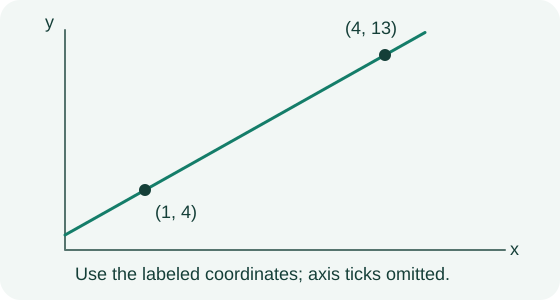
The graph marks two points on a line. What is its slope?
 Open full-size diagram ↗
- The change in y is 13 − 4 = 9.
- The change in x is 4 − 1 = 3.
- Slope = 9/3 = 3.
Compare the other answer choices
Divided one point’s coordinates instead of differences.
Reversed vertical change and horizontal change.
Reversed only one subtraction order.
Explain your thinking.
Optional written extension. Self-assessed only; it does not change your automatic practice result. These are teaching criteria, not official awarded marks.
Explain how the graph supports your rate. Write an equation for the line and check both plotted points.
This draft stays on this page only. Use paper if you want to keep your working.
Try it, then explain it.
Complete a short set without looking at the example. After each answer, explain which operation preserved the relationship and why the result makes sense.
Sources & authorship
Original Slope explanations and examples. References support the concepts; they are not the source of copied questions. Independent educator review is pending.
Official mathematics skillsSiyavula Grade 10 mathematicsSlope and slope-intercept form