
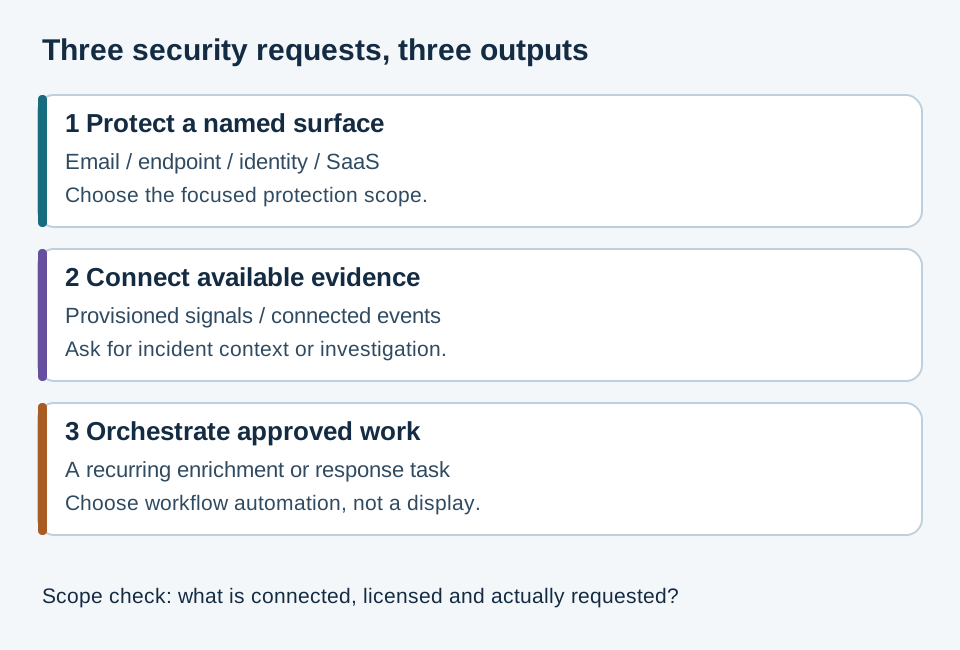
Use a fictional security review to split protection scope, connected evidence and approved operations. A product can participate in a case without answering every request.
A useful decision starts with an output
A tool comparison often fails before any product is named: the requester has asked for “better security” without specifying what work should change. A focused protection service, a joined incident view and a recurring response workflow can all help, but their outputs differ. This clinic starts with three short request cards. Each card identifies the protected surface or evidence input, the desired output and the conditions already satisfied. Treat the cards as separate jobs even when they belong to one broader investigation.
The method is deliberately different from memorizing a product-to-word table. A real competing option may supply a contributing input or solve a later task. To reject it fairly, explain the gap between what that option provides and the output requested now. Do not invent a narrow limitation to make an alternative fail. Equally, do not claim that the chosen capability secures everything simply because it is useful for this job.
Request card one: a focused protection surface
Fictional case: a small publishing cooperative wants focused protection against threats arriving through its email messages, links and collaboration environment. It also owns managed laptops and uses SaaS applications. The mere presence of those assets does not make every component the direct answer to the email request. Defender for Office 365 addresses the named email/collaboration surface. Defender for Endpoint addresses endpoint protection, and Defender for Cloud Apps addresses cross-SaaS visibility, data controls and threat protection.
Challenge the closest alternative honestly. Endpoint protection can matter if a laptop becomes involved in the resulting incident. That is a reason to retain an endpoint requirement, not a reason to rename the email-protection requirement. Write the first handoff as “protect the stated message/collaboration surface,” with its configuration and service scope still subject to review. This names a function without promising that all threats are prevented or all features are licensed.
Request card two: connect the incident evidence
The cooperative then supplies a different request: explain how signals from its licensed and provisioned Defender services relate in a possible incident. Defender XDR’s cross-product layer can join product alerts, behaviors and affected assets into incident context. That is not the same output as a focused email protection function. Preserve the evidence boundary: the documentation describes correlation of products licensed and provisioned for access. A joined view is not evidence that an unconnected application was observed.
The team may also need broader event ingestion and investigation across connected Microsoft and non-Microsoft sources. Sentinel SIEM supports that cross-source collection, analytics and investigation purpose. Do not force an exclusive “Defender or Sentinel” answer when the actual requests differ. Conversely, do not assume that adding either name establishes that the necessary data is already available. Ask which signals are connected, which incident question is being asked and what evidence would change the conclusion.
Request card three: carry out a recurring approved task
Finally, the cooperative has defined a recurring enrichment-and-routing procedure for incidents. It wants that approved procedure orchestrated, rather than another dashboard displaying the incident. Sentinel SOAR automation rules and playbooks address recurring enrichment, response and related tasks. A connector supplies source information; analytics can connect alerts; a workbook visualizes collected data. Each can support operations without itself being the named response-orchestration step.
Check the strongest alternative by changing the desired output. If the request were to proactively examine already connected data for a pattern before an alert exists, Sentinel hunting would be the closer fit. If the request were to integrate a missing supported source, a connector would matter first. Those changed conditions are meaningful counterexamples. They show why the original recurring-workflow request points to orchestration without implying that hunting or ingestion is inferior security work.
Keep posture and identity questions separate
A configuration-posture review introduces another evidence object. Defender for Cloud’s CSPM concerns cloud-resource posture and improvement, whereas CWPP concerns workload threat protection and DevSecOps concerns development/code security. If the cooperative’s request changes to configuration weaknesses, do not repeat the incident-correlation answer simply because the systems are cloud hosted. Choose by the new evidence request. Similarly, on-premises Active Directory signals point to Defender for Identity’s documented scope, while Entra ID Protection supplies identity-risk detection/investigation for its context.
These distinctions are boundaries on an inference, not instructions for operating a tenant. The clinic does not create resources, connect logs, execute remediation or prescribe attack steps. A capability match also does not establish that an incident is real. Investigation can reveal missing context, false positives or another explanation. Retain unknowns about scope and implementation rather than using a familiar service name to fill them.
Produce a reviewable handoff
Finish with one sentence per request: the named input or protected surface, the required output, the chosen capability and the strongest alternative’s different task. Add one evidence question that remains open, such as whether the relevant source is connected or the necessary service is provisioned. The resulting handoff is compact enough to review and concrete enough to challenge. It also makes it possible to revise one job without silently changing the others.
Use the checks below before opening their answers. They change the requested output rather than merely substituting another organization name. A successful explanation should follow the new conditions. These are original conceptual learning cases; they are not an official test, an incident-response playbook, a license recommendation or evidence of educator calibration. The diagrams show decision purposes, not a mandatory execution order for every security system.
Apply the guide
A fictional SOC already has connected source data and a known incident. It wants an approved repeated enrichment task executed automatically. A colleague proposes a new workbook. What output is still missing?Reveal explanation
The workbook can display collected evidence, but the requested output is orchestration/execution of the recurring approved task. Sentinel SOAR automation rules/playbooks address that task; no new data-source requirement was stated.
The request changes to proactive examination of already connected data for a suspected pattern before an alert exists. Should the previous orchestration answer be reused?Reveal explanation
No. The new output is investigative search/query work, fitting Sentinel hunting. Reuse the decision method, not the earlier product-feature answer. The already-connected-data condition avoids inventing an ingestion task.
Turn the idea into practice.
Apply the rule to a new case, then explain your choice.
Practice this skillSources & authorship
Original fictional decision clinic, checked against retained current Microsoft documentation on 2026-11-02. No official questions, diagrams or private tenant information reproduced.
Original OpenExam decision clinic with self-drawn conceptual figure.
Independent educator review is pending. This guide is not an official exam paper or a video transcript.
Microsoft Defender for Cloud Overview - Microsoft Defender for Cloud | Microsoft LearnWhat is Microsoft Defender XDR? - Microsoft Defender XDR | Microsoft LearnWhat is Microsoft Sentinel SIEM? | Microsoft LearnAutomation in Microsoft Sentinel | Microsoft Learn