
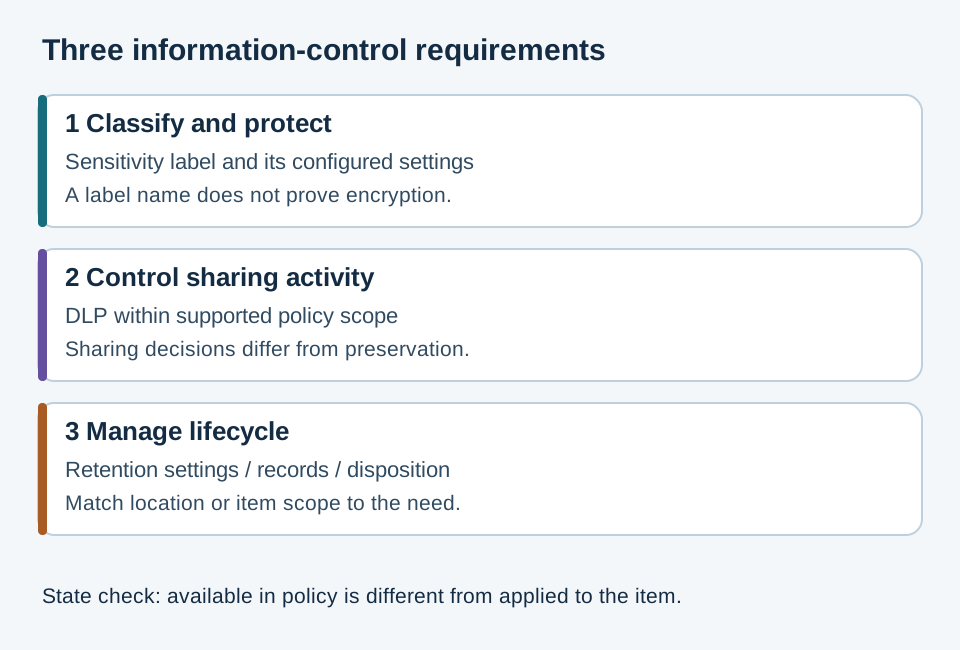
Review a fictional editorial archive proposal by separating protection, sharing activity and lifecycle. Then check whether the proposed control is actually applied to the named content.
Begin with the document’s requirements
An information-control proposal can contain several correct product names and still miss the actual requirement. A sensitivity label, a retention setting and a DLP policy serve different purposes. This clinic reviews a fictional archive proposal rather than asking for a single universal label. Write three rows: classification/protection, sharing activity and lifecycle. For each row, record the organizational requirement and the evidence that the proposed configuration addresses it. The rows help preserve an existing control when a new requirement is added.
The method has a second stage: distinguish a well-chosen control purpose from evidence that the control reaches the named item or activity. An available label is not an applied label. A policy’s scope is not every possible location. A retention duration invented by a learner is not a justified legal requirement. The examples use fictional internal instructions and supported-content assumptions; they do not determine anyone’s statutory obligations.
Read the fictional editorial proposal
A small oral-history archive keeps interview transcripts in supported Microsoft 365 locations. Its proposal says the transcripts already have a sensitivity label configured for the archive’s protection needs. A new internal requirement concerns inappropriate sharing of sensitive excerpts. Another requirement concerns how long selected material should be retained. The proposal offers one change: rename the existing label to include a retention phrase and assume that all three requirements are now satisfied.
The name is weak evidence because the controls’ purposes and configuration do the work. Keep the existing sensitivity protection as its own row. Evaluate a DLP policy for the sharing-activity requirement within supported configured locations and activities. Evaluate appropriate retention settings for lifecycle. The proposal needs actual configuration/evidence for each new row; a display name is not that configuration. This is an evidence review, not a recommendation to deploy every available control.
Protection is not a lifecycle schedule
Sensitivity labels classify content and can apply configured protection. Their settings matter: not every sensitivity label necessarily encrypts content. Retention policies and labels govern lifecycle, while records management can use configured retention labels for record declaration and disposition review. Sensitivity and retention labels can coexist on supported content. Adding lifecycle settings therefore need not mean removing correctly configured information protection.
Challenge a tempting alternative. Replacing a sensitivity label with a retention label might address a lifecycle purpose, but it does not by that fact preserve the separately required protection configuration. Conversely, keeping the sensitivity label says little about the requested retention behavior. The right review asks whether both requirements remain satisfied. It does not infer that every document needs the same protection, record declaration, retention period or disposition workflow.
Location scope and item scope are meaningful conditions
The archive then changes its workflow: selected documents move between supported containers, and the internal requirement says retention must stay associated with the document after a move. A policy applied only to the original location does not travel with content outside that container. Item-associated retention labels are therefore relevant to the changed scope. If the documents instead remained within a defined location and the requirement concerned that location, a location policy could be a valid approach.
This counterexample matters because it keeps the competition honest. A location policy is not a fake control or an inherently wrong answer. It fails the particular moves-with-item condition when offered as the sole lifecycle mechanism. Use the positive scope facts to make the distinction. If supported item types, destinations or settings are unspecified, preserve those uncertainties rather than assuming every move and application behaves identically.
Availability is not application
Another reviewer shows that an appropriate retention label has been published to users. That can establish availability within its publication scope. It does not itself establish that the named document has received the label. Actual user/administrator application is a separate operation; an applicable automatic-application configuration is another arrangement that needs its own conditions. A screenshot of a selection list therefore answers a different question from evidence of the item’s actual label state.
The same discipline applies to DLP. The existence of a policy is not proof that a particular activity at an unspecified location is covered or that a particular outcome occurred. Evaluate supported scope, conditions and actions. DLP can identify, monitor and help protect sensitive information against inappropriate sharing; retention preserves or manages lifecycle. Preserving a document is not the same decision as permitting or restricting a sharing activity involving it.
Separate operational and investigation evidence
The archive may later need to review recorded activities or identify responsive content for a case. Audit search addresses supported user/admin operation records; eDiscovery addresses content identification and case preservation/search/export capabilities. These can contribute evidence about a control or investigation, but they do not replace the original protection, sharing and lifecycle configuration. A search result also is not a legal finding or a complete history of every operation.
End with a concise review record: the three requirements, their proposed controls, the relevant scope and the evidence of actual application or operation. Mark any unsupplied fact unknown. Application checks reinforce these distinctions; prior lesson/example exposure applies. Explain the difference before reading the answer. No actual transcripts, tenant settings, policies, holds or exports are created in this clinic; educator review and learner trials remain pending.
Apply the guide
A fictional archive publishes a retention label and confirms users can select it. The reviewer asks whether a particular transcript is assigned that label. What additional evidence is needed?Reveal explanation
Evidence of the transcript’s actual label application/state, or an applicable automatic-application arrangement and its result. Publication establishes availability within scope, not item assignment.
A fictional policy concerns inappropriate sharing of sensitive excerpts, while a separate lifecycle requirement is already configured. A colleague proposes extending retention as the solution to the sharing requirement. What distinction should the review preserve?Reveal explanation
Longer lifecycle retention does not implement the sharing-activity policy. Evaluate a relevant DLP policy with supported locations/activities/conditions while retaining the separate lifecycle requirement; do not infer coverage from the policy name alone.
Turn the idea into practice.
Apply the rule to a new case, then explain your choice.
Practice this skillSources & authorship
Original fictional decision clinic, checked against retained current Microsoft documentation on 2026-11-02. No official questions, diagrams or private tenant information reproduced.
Original OpenExam decision clinic with self-drawn conceptual figure.
Independent educator review is pending. This guide is not an official exam paper or a video transcript.
Learn about auditing solutions in Microsoft Purview | Microsoft LearnLearn about data loss prevention | Microsoft LearnLearn about eDiscovery | Microsoft LearnLearn about sensitivity labels | Microsoft LearnLearn about retention policies & labels to retain or delete | Microsoft LearnRecords management for documents and emails in Microsoft 365 | Microsoft Learn