
Recognize the controlling condition
Separate biological, chemical, and physical hazards before choosing a control. A cold temperature, a clean appearance, or a low price answers none of those questions by itself. Identify where the hazard enters and whether the food will receive another effective treatment. A raw-animal-food surface can transfer pathogens to food that will receive no further cooking. Chemical identification and separation prevent accidental food contamination and misuse. Small glass fragments may be present even when they cannot be seen. Food Code protections for highly susceptible populations restrict certain higher-risk foods.
Work a decision from its evidence
A cook uses the same unwashed cutting board for raw chicken and ready-to-eat melon. The appropriate response is to clean and sanitize the board before cutting the melon. The decisive reason is: A raw-animal-food surface can transfer pathogens to food that will receive no further cooking. Compare the tempting alternative "Wipe the board with a dry towel and continue.". A dry wipe does not perform the required cleaning and sanitizing steps. Before choosing, identify the specific condition that makes this rule applicable. Do not transfer a number, exception, or permission to a different situation without checking its conditions.
Contrast a different mistake
A worker places an unlabeled spray bottle beside an open bowl of salad ingredients. Here the appropriate response is: Identify and store the bottle away from food. A different proposed response is "Use the bottle on food-contact surfaces without checking its label.". An unidentified liquid cannot be assumed to be an approved food-contact sanitizer. The difference between these cases is the source of the risk or obligation, not a change in the decision maker's preference. Explain the distinction before reading the answer to the linked example.
Apply and check the method
For each new case, name the contamination route and explain why the proposed control interrupts that route. If the route involves raw food reaching a ready-to-eat item, temperature alone does not provide separation. If the hazard is physical or chemical, cooking may not remove it. For biological contamination, ask whether the proposed response addresses this condition: A raw-animal-food surface can transfer pathogens to food that will receive no further cooking. For chemical contamination, ask whether the proposed response addresses this condition: Chemical identification and separation prevent accidental food contamination and misuse. For physical contamination, ask whether the proposed response addresses this condition: Small glass fragments may be present even when they cannot be seen. For highly susceptible populations, ask whether the proposed response addresses this condition: Food Code protections for highly susceptible populations restrict certain higher-risk foods. Check the explanation against the cited reference, then answer the associated case items without using the option length or answer position as a clue.
A cook uses the same unwashed cutting board for raw chicken and ready-to-eat melon. What is the most appropriate response?
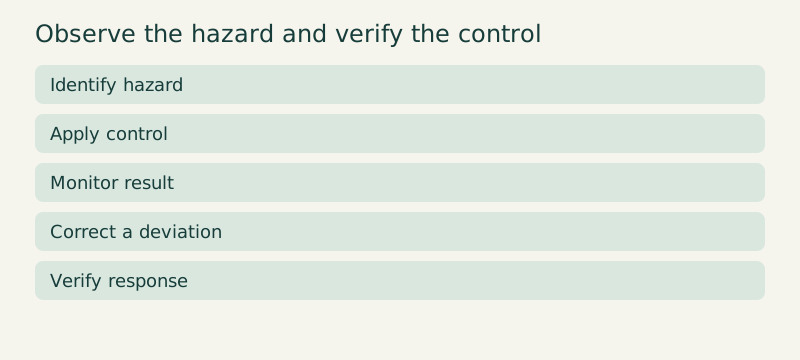 Open full-size diagram ↗
- Identify the controlling condition: Biological contamination.
- A raw-animal-food surface can transfer pathogens to food that will receive no further cooking.
- Apply it: Clean and sanitize the board before cutting the melon.
- Compare the alternative "Wipe the board with a dry towel and continue.": A dry wipe does not perform the required cleaning and sanitizing steps.
Compare the other answer choices
A dry wipe does not perform the required cleaning and sanitizing steps.
Rinsing afterward is not a reliable corrective control for the contaminated ready-to-eat food.
Refrigeration does not make raw poultry free of pathogens.
Try it, then explain it.
Complete a short set without looking at the example. After each answer, explain which evidence or rule supports your decision and why the alternatives do not fit.
Sources & authorship
Original Slope explanations and examples. References support the concepts; they are not the source of copied questions. Independent educator review is pending.
FDA Food Code 2022, January 18,2023 version