All examsACT MathFoundation path
View coverage
FREE ORIGINAL PRACTICE · ANSWERS & EXPLANATIONS

ACT Math Practice Questions & Answers

Build ACT Math foundations through clear methods, original questions and visual explanations.

Read 10 original sample questions with worked explanations before opening the practice studio. These examples introduce selected topics from this ACT Math foundation path.

Free access · No sign-up · No personal progress recorded on this page

What this practice covers

Selected enhanced ACT Math foundations

All 400 questions use four-option multiple choice, matching the enhanced ACT Math response form. This is an untimed foundation pilot, not a full official simulation.

10 public examples400 question variants in the studio96 task families

Review status: Independent educator review and learner calibration are pending. Use these selected foundation examples alongside the coverage map and current official references.

Check the coverage map and remaining gaps
CHOOSE A STARTING POINT

Topics in this foundation path

The examples below span 6 of 6 learning domains. Counts describe the current catalog, not the exam's official weighting.

TRY A QUESTION. FOLLOW THE REASONING.

Sample questions with answers

Work out your answer first, then compare the explanation. This stable selection uses distinct task families across the available learning domains.

QUESTION 01Number & Quantity

Numbers, vectors & matrices

What is 3/6 − 1/4?

  1. 1/4
  2. 3/4
  3. 1/3
  4. 2/5

Answer: 1/4

  1. Use denominator 12: 6/12 − 3/12.
  2. Subtract the numerators and reduce the fraction.
  3. The requested value is 1/4.
Compare the other answer choices
2/5

Add numerators and denominators instead of subtracting fractions.

1/3

Keep denominator six while subtracting numerators without converting.

3/4

Add the fractions rather than subtract.

Reference basis: ACT Mathematics content. These are original learning questions, not questions reproduced from the references.

QUESTION 02Algebra

Equations with restrictions

If 4x − 8 = 2x + 10, what is x?

  1. 3
  2. 9/2
  3. 18
  4. 9

Answer: 9

  1. Subtract 2x from both sides and add the constant on the left.
  2. Divide by the remaining coefficient.
  3. The requested value is 9.
Compare the other answer choices
3

Add rather than subtract the x coefficients.

18

Stop before dividing by the x coefficient.

9/2

Ignore the 2x term on the right.

Reference basis: ACT Mathematics content. These are original learning questions, not questions reproduced from the references.

QUESTION 03Functions

Functions as input rules

f(x) = 2x + 3 for x < 0 and f(x) = x² − 3 for x ≥ 0. What is f(−4)?

  1. -19
  2. 13
  3. -11
  4. -5

Answer: -5

  1. The input is negative, so use the first branch.
  2. Substitute the negative input into the linear rule.
  3. The requested value is -5.
Compare the other answer choices
13

Use the nonnegative-input branch.

-11

Subtract the branch constant instead of adding.

-19

Square the negative input with the wrong sign and use the wrong branch.

Reference basis: ACT Mathematics content. These are original learning questions, not questions reproduced from the references.

QUESTION 04Geometry

Coordinate geometry connections

A line has slope 3/3. What is the slope of a perpendicular line?

  1. 0
  2. -1
  3. 1
  4. -1/2

Answer: -1

  1. For two nonvertical perpendicular lines, the slopes multiply to −1.
  2. Take the reciprocal and change its sign.
  3. The requested value is -1.
Compare the other answer choices
0

Treat perpendicular as horizontal regardless of the original slope.

1

Take the reciprocal but omit the negative sign.

-1/2

Divide the reciprocal slope by two as if averaging directions.

Reference basis: ACT Mathematics content. These are original learning questions, not questions reproduced from the references.

QUESTION 05Statistics & Probability

Summaries from data

A class of 3 students has mean score 60; another class of 6 students has mean 90. What is the combined mean?

  1. 75
  2. 70
  3. 80
  4. 50

Answer: 80

  1. Convert each mean into a total by multiplying by its group size.
  2. Add the totals and divide by the total number of students.
  3. The requested value is 80.
Compare the other answer choices
50

Divide the sum of means by the number of size parts.

70

Assign the larger weight to the wrong group.

75

Average group means without size weights.

Reference basis: ACT Mathematics content. These are original learning questions, not questions reproduced from the references.

QUESTION 06Integrating Essential Skills

Rates, scales & mixtures

A map scale is 1 cm to 3 km. Two towns are 4 cm apart on the map. How many kilometers apart are they?

  1. 3
  2. 12
  3. 4/3
  4. 1200

Answer: 12

  1. Each map centimeter represents the stated real distance.
  2. Multiply map distance by kilometers per centimeter; centimeters cancel.
  3. The requested value is 12.
Compare the other answer choices
3

Report distance per centimeter rather than total distance.

1200

Incorrectly multiply the kilometer result by 100 using a centimeters-per-meter factor.

4/3

Divide by the map conversion factor.

Reference basis: ACT Mathematics content. These are original learning questions, not questions reproduced from the references.

QUESTION 07Number & Quantity

Vectors and matrix structure

Vectors u=(3,−2) and w=(3,5) are given. What is the second component of 2 u−w?

  1. 3
  2. -7
  3. -14
  4. -9

Answer: -9

  1. Compute the second component only: 2(−2) minus the second component of w.
  2. Apply the scalar before subtracting the vector.
  3. Substitute the given numbers: 2 × (-2)-5 = -9.
  4. Therefore the requested value is -9.
Compare the other answer choices
3

Report the first component instead of the requested second component.

-7

Forget to multiply the second component of u by 2.

-14

Multiply the subtracted component of w by 2 as well.

Reference basis: ACT Mathematics content. These are original learning questions, not questions reproduced from the references.

QUESTION 08Algebra

Systems and practical constraints

The equations x + y = 10 and x − y = 4 hold. What is y?

  1. 3
  2. 7
  3. 4
  4. -3

Answer: 3

  1. Subtract the second equation from the first to eliminate x.
  2. The resulting equation has 2y on the left; divide by 2.
  3. The requested value is 3.
Compare the other answer choices
4

Report x−y instead of y.

7

Add the equations and report x.

-3

Subtract the equations in reverse order without changing the sign.

Reference basis: ACT Mathematics content. These are original learning questions, not questions reproduced from the references.

QUESTION 09Functions

Read quadratic structure

For real x, what is the minimum value of y = 2(x − 3)² + 4?

  1. 8
  2. 3
  3. 4
  4. -4

Answer: 4

  1. The square is nonnegative for every real input.
  2. It becomes zero at the horizontal vertex coordinate, leaving only the vertical offset.
  3. The requested value is 4.
Compare the other answer choices
3

Report the horizontal vertex coordinate.

8

Multiply the offset by the leading coefficient.

-4

Reverse the vertical shift sign.

Reference basis: ACT Mathematics content. These are original learning questions, not questions reproduced from the references.

QUESTION 10Geometry

Geometry with dimensions

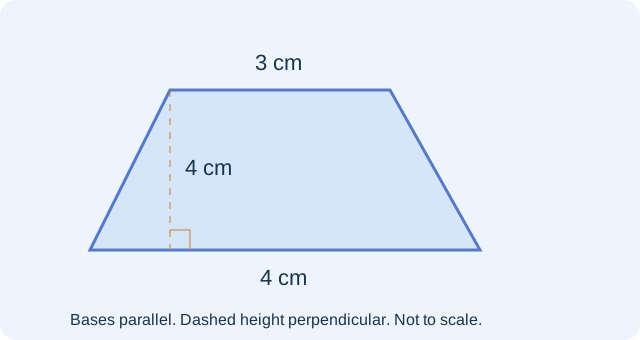
Use the dimensions in the trapezoid diagram. What is its area in square centimeters?

Trapezoid has parallel bases 3 cm and 4 cm, perpendicular height 4 cm.Open full-size diagram ↗
  1. 28
  2. 12
  3. 14
  4. 24

Answer: 14

  1. Average the two parallel base lengths.
  2. Multiply this average by the perpendicular height.
  3. The requested value is 14.
Compare the other answer choices
12

Use only the shorter base.

24

Use the mistaken area model base1 × base2 × height / 2, treating both parallel bases as multiplicative dimensions.

28

Omit the one-half in the trapezoid area formula.

Reference basis: ACT Mathematics content. These are original learning questions, not questions reproduced from the references.

BUILD ON WHAT YOU NOTICED

Turn one question into a learning route

Start with the lesson linked to an unfamiliar topic, try a focused set in the practice studio, then return to the review cards. Your practice progress stays in this browser.

Scope, sources and review notes

Catalog scope record: . This records the saved content mapping, not a guarantee that every external rule is current.

  • 400 parameterized questions across 96 families, not 400 independent designs
  • Selected foundations, not complete ACT syllabus coverage
  • Independent educator review pending; no ACT score prediction
  • Foundation pilot, not full syllabus coverage or official simulation
  • Question variants are not independent question designs
  • Independent educator review pending
  • Evidence integrity and structure checks do not establish factual or audiovisual fidelity

Check the exam provider's current information for registration, test rules and official preparation materials. The exam guide collects the relevant official references.

REFERENCEACT Mathematics content

official facts and syllabus reference; not copied questions