
A reliable method
For a mean, find the sum and the number of observations separately. For a median, sort the data and average the two central entries when the count is even.
The common trap
Averaging two group means without considering group size can give the wrong overall mean when the groups have unequal sizes; weight each mean by its group size.
Check and transfer
Check how a transformation affects a summary. Adding a constant moves the mean and median but leaves the distance between the smallest and largest values unchanged.
Worked comparison: why the alternative fails
Two students average 3 books and six students average 7 books. The combined mean is (2×3+6×7)/8=6. Averaging 3 and 7 gives 5 and overweights the small group. A valid weighted mean remains between 3 and 7.
Transfer and explain
For 2, 4, 8, 12, the median is (4+8)/2=6 while the mean is 26/4=6.5. Neither summary is automatically interchangeable with the other.
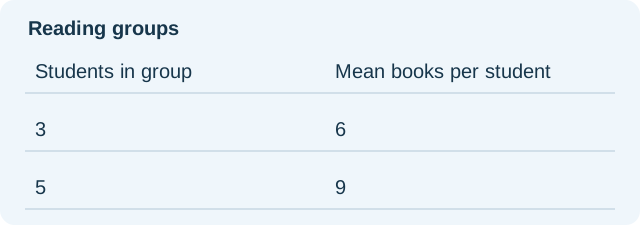
The first reading group has 3 students. Use both groups in the table to find the mean number of books per student across all students.
 Open full-size diagram ↗
- Recover each group total by multiplying its mean by its size.
- Add the totals and divide by the combined number of students.
- The requested value is 63/8. Check its units and meaning against the original question.
Compare the other answer choices
Use only the first group mean.
Average the two group means without weighting their different sizes.
Swap the group sizes attached to the two means.
Explain your thinking.
Optional written extension. Self-assessed only; it does not change your automatic practice result. These are teaching criteria, not official awarded marks.
Explain your model, identify a tempting alternative and show why it fails. This extension is self-assessed and does not affect automatic scoring.
This draft stays on this page only. Use paper if you want to keep your working.
Try it, then explain it.
Complete a short set without looking at the example. After each answer, explain which operation preserved the relationship and why the result makes sense.
Sources & authorship
Original Slope explanations and examples. References support the concepts; they are not the source of copied questions. Independent educator review is pending.
GED Mathematical Reasoning overviewSiyavula Grade 10 mathematics foundation reference