FREE ORIGINAL PRACTICE · ANSWERS & EXPLANATIONS

ACCUPLACER Math Practice Questions & Answers

Selected Arithmetic, QAS, and AAF foundations for college math placement.. Selected foundation practice, not a complete exam simulation.

Try 10 original samples with answers below, or start a personal practice set.

Free access · No sign-up · No personal progress recorded on this page · Coverage & review notes

TRY A QUESTION. FOLLOW THE REASONING.

Sample questions with answers

Work out your answer first, then compare the explanation. This stable selection uses distinct task families across the available learning domains.

QUESTION 01Arithmetic

Number sense, fractions, decimals, and percents

A lab bottle contains 0.36 liter of a solution. A technician uses 0.75 of the amount in the bottle. How many liters does the technician use?

  1. 0.09
  2. 0.027
  3. 0.27
  4. 0.48

Answer: 0.27

  1. Taking 0.75 of the amount means multiplying the whole amount by 0.75. Since 0.75 is between zero and one, the result must be smaller than 0.36 liter.
  2. Find three fourths of 0.36: one fourth is 0.09 liter, and three of those parts give 0.27 liter.
Compare the other answer choices
0.09

One fourth of 0.36 liter is 0.09 liter. That is the quarter left in the bottle. The technician uses three fourths.

0.027

Starting with 2700 and moving the decimal point five places gives 0.027. The two factors each contribute two places, so the product uses four.

0.48

Dividing 0.36 by 0.75 gives 0.48. That would find a whole whose 0.75 share is 0.36 liter. Here 0.36 liter is already the whole.

Reference basis: College Board ACCUPLACER Math test content; OpenStax Prealgebra 2e. These are original learning questions, not questions reproduced from the references.

QUESTION 02Quantitative Reasoning, Algebra, and Statistics (QAS)

Ratios, rates, and percent change

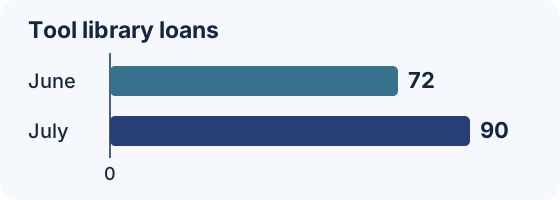
The chart shows the number of loans a tool library recorded in June and July. By what percent did the loan count increase from June to July?

Two bars on a common zero scale show 72 loans in June and 90 loans in July.
June and July counts on the same scale.
Open full-size diagram ↗
  1. 20%
  2. 25%
  3. 18%
  4. 125%

Answer: 25%

  1. The words “from June” set the reference count at 72 loans. July adds 90 − 72 = 18 loans.
  2. Divide the increase by the starting count: 18 ÷ 72 = 1/4 = 0.25. The loan count increased by 25%. Adding one quarter of the June count back to the June count reproduces July. Check that 72 × 1.25 = 90.
Compare the other answer choices
20%

The increase is 18 loans, and 18 ÷ 90 = 0.20. That uses the July count as the base. A change from June to July is measured against June.

18%

Subtracting the counts gives 18 loans. That is the size of the increase in loans. To express it as a percent, divide by the starting number of loans first.

125%

The ratio 90 ÷ 72 is 1.25, so July is 125% of June. Subtract the original 100% to isolate the increase.

Reference basis: College Board ACCUPLACER Math test content; OpenStax Prealgebra 2e. These are original learning questions, not questions reproduced from the references.

QUESTION 03Advanced Algebra and Functions (AAF)

Factoring, quadratic equations, and graphs

Which option gives all real solutions of (x − 2)² = 25?

  1. x = −3 or x = 7
  2. x = 7 only
  3. x = −7 or x = 3
  4. x = −5 or x = 5

Answer: x = −3 or x = 7

  1. The entire expression x − 2 is squared. Both 5 and −5 have square 25, so solve x − 2 = 5 and x − 2 = −5.
  2. Adding 2 in each equation gives 7 and −3. Substitute to check: 7 − 2 = 5, and −3 − 2 = −5. Both squares equal 25. Keeping the negative inner value is necessary because squaring erases the sign.
Compare the other answer choices
x = 7 only

Taking x − 2 = 5 gives x = 7. The other branch x − 2 = −5 also squares to 25 and gives a second solution.

x = −7 or x = 3

Subtracting 2 from both 5 and −5 gives 3 and −7. To isolate x in x − 2 = ±5, add 2 to both branches.

x = −5 or x = 5

Both 5 and −5 square to 25. They are possible values of the expression x − 2. The last step shifts each value by 2 to find x.

Reference basis: College Board ACCUPLACER Math test content; OpenStax Intermediate Algebra 2e. These are original learning questions, not questions reproduced from the references.

QUESTION 04Quantitative Reasoning, Algebra, and Statistics (QAS)

Linear equations, slope, and intercepts

A workshop charges a one-time setup fee plus the same price for each panel cut. An order of 3 panels costs $17 and an order of 8 panels costs $32. What is the setup fee?

  1. $8
  2. $3
  3. $17
  4. $14

Answer: $8

  1. Subtract the total prices and the quantities to isolate the variable charge. Five more panels cost $15 more, so each panel costs $3.
  2. The order of three panels contains $9 in variable charges. Subtract $9 from $17 to get the $8 setup fee. Checking the larger order gives 8 + 8 × 3 = 32.
Compare the other answer choices
$3

The cost difference is $15 for five extra panels. The resulting $3 is the price per panel.

$17

The smaller order costs $17 in total. It includes the setup fee and the price of three panels.

$14

Subtracting one panel price from $17 leaves $14. Subtract the cost of all three panels to isolate setup.

Reference basis: College Board ACCUPLACER Math test content; OpenStax Elementary Algebra 2e. These are original learning questions, not questions reproduced from the references.

QUESTION 05Advanced Algebra and Functions (AAF)

Function notation and domain restrictions

A function has rule f(t) = 2t + 4 when t < 3 and rule f(t) = t² − 2 when t ≥ 3. What is f(3)?

  1. 10
  2. 7
  3. 9
  4. 11

Answer: 7

  1. The equality in t ≥ 3 includes the input three, so use the second rule. The first inequality is strict and does not include three.
  2. Substitute the input into t² − 2. The square gives nine, and subtracting two gives seven.
Compare the other answer choices
9

Squaring three gives nine. The rule also subtracts two.

10

Using the first rule gives 2 × 3 + 4 = 10. That rule applies only to inputs strictly below three.

11

Adding two to the square gives eleven. The selected rule subtracts two.

Reference basis: College Board ACCUPLACER Math test content; OpenStax Intermediate Algebra 2e; OpenStax College Algebra 2e. These are original learning questions, not questions reproduced from the references.

QUESTION 06Quantitative Reasoning, Algebra, and Statistics (QAS)

Data displays, summaries, and probability

Four attendance counts have a mean of 11. Three counts are 8, 10, and 12. What is the fourth count?

  1. 3
  2. 11
  3. 14
  4. 44

Answer: 14

  1. The mean equals the total divided by the number of counts. With four counts and mean eleven, the total must be forty-four.
  2. The known counts sum to thirty. Subtract that from forty-four to get fourteen. Verify the resulting four-count mean by dividing forty-four by four.
Compare the other answer choices
3

Multiplying the mean by three and subtracting the known sum gives 33 − 30 = 3. The target mean describes four counts.

11

Using the mean itself as the missing count gives a total of 41. Dividing by four gives 10.25, so this misses the target.

44

The required total is four times 11, or 44. Subtract the known counts to obtain the missing one.

Reference basis: College Board ACCUPLACER Math test content; OpenStax Prealgebra 2e. These are original learning questions, not questions reproduced from the references.

QUESTION 07Arithmetic

Number sense, fractions, decimals, and percents

Two sections of a trail are 3/10 mile and 5/12 mile long. What is their total length in miles?

  1. 43/60
  2. 4/11
  3. 2/15
  4. 23/60

Answer: 43/60

  1. The tenths and twelfths represent different-sized pieces. Rename both in sixtieths so they can be added.
  2. Multiply the numerator and denominator of 3/10 by 6 to get 18/60. Multiply those of 5/12 by 5 to get 25/60. The total is 43/60 mile.
Compare the other answer choices
4/11

Adding tops and bottoms gives (3 + 5)/(10 + 12) = 8/22 = 4/11. Those denominators count different-sized pieces.

2/15

Using denominator 60 with unchanged numerators gives (3 + 5)/60 = 8/60 = 2/15. Both numerators must change when the pieces are renamed.

23/60

Converting only 3/10 to 18/60 and leaving the numerator 5 unchanged gives 23/60. The second addend is 25/60.

Reference basis: College Board ACCUPLACER Math test content; OpenStax Prealgebra 2e. These are original learning questions, not questions reproduced from the references.

QUESTION 08Arithmetic

Number sense, fractions, decimals, and percents

A coating machine uses 0.35 liter of finish for each square meter. How many square meters can it cover with 0.84 liter at that rate?

  1. 0.24
  2. 24
  3. 0.294
  4. 2.4

Answer: 2.4

  1. Divide available liters by liters needed per square meter. The liters cancel, leaving square meters.
  2. Multiply the dividend and divisor by 100 to get 84 ÷ 35 = 2.4. Check that 2.4 square meters at the given rate uses exactly 0.84 liter.
Compare the other answer choices
24

Dividing 0.84 by 0.035 gives 24. Shifting the decimal of only the divisor changes the amount required per square meter.

0.24

Changing the divisor from 0.35 to 3.5 without changing the dividend gives 0.84 ÷ 3.5 = 0.24. Scale both numbers by the same factor.

0.294

Multiplying 0.84 × 0.35 gives 0.294. To find square meters from liters, divide by liters per square meter.

Reference basis: College Board ACCUPLACER Math test content; OpenStax Prealgebra 2e. These are original learning questions, not questions reproduced from the references.

QUESTION 09Arithmetic

Number sense, fractions, decimals, and percents

A shop charges a deposit equal to 15% of the total repair price. The deposit is $18. What is the total repair price?

  1. $2.70
  2. $120.00
  3. $33.00
  4. $20.70

Answer: $120.00

  1. Let P be the total repair price. The deposit is fifteen hundredths of P, so 0.15P = 18.
  2. Divide 18 by 0.15 to get 120 dollars. Checking in the original relationship, fifteen percent of $120 is exactly $18.
Compare the other answer choices
$2.70

Multiplying $18 by 0.15 gives $2.70. The $18 is already a percentage of the price, so divide to recover the total.

$33.00

Adding 15 dollars to 18 dollars gives $33. A 15% deposit describes a fraction of the price, with no separate 15-dollar amount.

$20.70

Adding 15% of $18 to $18 gives $20.70. That treats the deposit as a starting price with a surcharge.

Reference basis: College Board ACCUPLACER Math test content; OpenStax Prealgebra 2e. These are original learning questions, not questions reproduced from the references.

QUESTION 10Arithmetic

Number sense, fractions, decimals, and percents

Which of these numbers is greatest?

  1. 0.73
  2. 71%
  3. 3/4
  4. 7/10

Answer: 3/4

  1. Convert each number to hundredths for a common comparison. The decimal gives 73, the percent gives 71, and seven tenths gives 70 hundredths.
  2. Three fourths equals 75 hundredths because each fourth contains 25 hundredths. The greatest count of hundredths is 75.
Compare the other answer choices
0.73

Comparing only the decimal and the percent makes 0.73 look greatest. The fraction 3/4 equals 75 hundredths, which is greater by two hundredths.

71%

Comparing the displayed 71 directly with the decimal values ignores the percent sign. This is 71 hundredths.

7/10

A larger numerator does not ensure a larger value when the denominators differ. This is 70 hundredths.

Reference basis: College Board ACCUPLACER Math test content; OpenStax Prealgebra 2e. These are original learning questions, not questions reproduced from the references.

What this practice covers

Selected Arithmetic, QAS, and AAF foundations for college math placement.

Work through original practice in number sense, quantitative reasoning, and advanced algebra.

Fixed four-option practice. Feedback explains your choices.

10 public examples24 question variants in the studio24 task families

Review status: Independent educator review and learner calibration are pending. Use these selected foundation examples alongside the coverage map and current official references.

Check the coverage map and remaining gaps
CHOOSE A STARTING POINT

Topics in this foundation path

The examples span 3 of 3 learning domains. Counts describe the current catalog, not the exam's official weighting.

BUILD ON WHAT YOU NOTICED

Turn one question into a learning route

Start with the lesson linked to an unfamiliar topic, try a focused set in the practice studio, then return to the review cards. Your practice progress stays in this browser.

Scope, sources and review notes

Catalog scope record: . This records the saved content mapping, not a guarantee that every external rule is current.

  • The practice samples selected topics from three math tests, with an emphasis on QAS.
  • Practice results describe performance on this set. The official assessment uses adaptive selection and scaled scores.
  • Difficulty labels are editorial estimates. Educator review is pending.

Check the exam provider's current information for registration, test rules and official preparation materials. The exam guide collects the relevant official references.

OFFICIAL REFERENCECollege Board ACCUPLACER Math test content

Identifies the three math tests, adaptive format and official topics.

REFERENCEOpenStax Prealgebra 2e

Method reference for whole numbers, fractions, decimals, ratios, and percents.

REFERENCEOpenStax Elementary Algebra 2e

Reference scope, facts or methods only. Use independently authored teaching and link to original. Reproduction permission not relied upon.

REFERENCEOpenStax Intermediate Algebra 2e

Method reference for functions, quadratic equations, and graphs.

REFERENCEOpenStax College Algebra 2e

Reference scope, facts or methods only. Use independently authored teaching and link to original. Reproduction permission not relied upon.