Study refrigerant recovery, appliance boundaries and source-grounded service decisions through original learning tasks.
Read 10 original sample questions with worked explanations before opening the practice studio. These examples introduce selected topics from this EPA 608 foundation path.
Free access · No sign-up · No personal progress recorded on this page
What this practice covers
Selected Core and Type I/II/III written-knowledge foundations
Four-option original learning questions, including stated-rule calculations and scenario decisions. Not an EPA-approved test or field skills assessment.
10 public examples200 question variants in the studio48 task families
Review status: Independent educator review and learner calibration are pending. Use these selected foundation examples alongside the coverage map and current official references.
Work out your answer first, then compare the explanation. This stable selection uses distinct task families across the available learning domains.
QUESTION 01Core
Certification and appliance boundaries
A technician will service a factory-sealed household freezer containing 4 lb of refrigerant. Which certification category directly covers this small appliance?
Section 609 MVAC certification
Type I
Type II
Type III
Answer: Type I
The relevant stated condition is: A technician will service a factory-sealed household freezer containing 4 lb of refrigerant.
Apply the relevant source rule. Classify the appliance before selecting a certification. Type I, II and III have different equipment scopes.
This supports “Type I”. The alternative “Type II” uses a different condition or conclusion;the applicable rule above explains why it does not answer this case.
Compare the other answer choices
Type II
Type II covers high- and very-high-pressure equipment except small appliances and MVAC s.
Type III
Type III covers low-pressure appliances.
Section 609 MVAC certification
Section 609 concerns motor-vehicle air conditioning; stationary appliance categories must not be substituted.
Reference basis: Epa Certification. These are original learning questions, not questions reproduced from the references.
QUESTION 02Type I
Recognizing small appliances
A factory-sealed window air conditioner contains 3 lb. Which charge band applies to the small-appliance recovery decision?
At least two hundred pounds
More than five pounds
Five pounds or fewer
At least fifty pounds
Answer: Five pounds or fewer
The relevant stated condition is: A factory-sealed window air conditioner contains 3 lb.
Apply the relevant source rule. A small appliance is fully manufactured, charged and hermetically sealed in a factory with five pounds or less of refrigerant. Both the construction definition and charge condition matter; small-looking equipment alone does not qualify.
This supports “Five pounds or fewer”. The alternative “More than five pounds” uses a different condition or conclusion;the applicable rule above explains why it does not answer this case.
Compare the other answer choices
More than five pounds
This choice (More than five pounds) does not fit the stated conditions. A small appliance is fully manufactured, charged and hermetically sealed in a factory with five pounds or less of refrigerant. Both the construction definition and charge condition matter; small-looking equipment alone does not qualify.
At least fifty pounds
This choice (At least fifty pounds) does not fit the stated conditions. A small appliance is fully manufactured, charged and hermetically sealed in a factory with five pounds or less of refrigerant. Both the construction definition and charge condition matter; small-looking equipment alone does not qualify.
At least two hundred pounds
This choice (At least two hundred pounds) does not fit the stated conditions. A small appliance is fully manufactured, charged and hermetically sealed in a factory with five pounds or less of refrigerant. Both the construction definition and charge condition matter; small-looking equipment alone does not qualify.
Reference basis: Epa Reg Definitions. These are original learning questions, not questions reproduced from the references.
QUESTION 03Type II
High- and medium-pressure evacuation
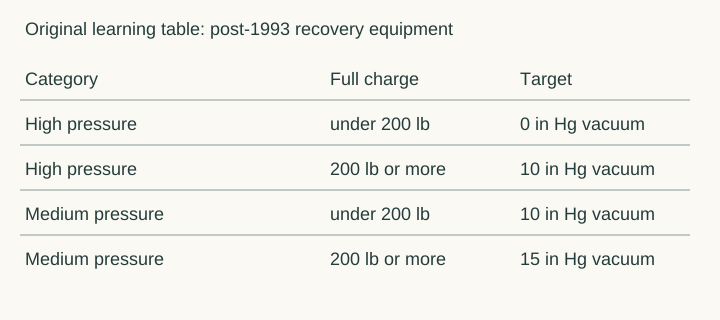
A high-pressure stationary appliance has a full charge of 50 lb. Recovery equipment was manufactured after November 15, 1993. In EPA's general service evacuation table, which target applies?
The relevant stated condition is: A high-pressure stationary appliance has a full charge of 50 lb.
Apply the relevant source rule. The appliance is high-pressure and its full charge is less than 200 lb. The post-1993 column therefore gives 0 inches Hg vacuum.
This supports “0 inches Hg vacuum”. The alternative “4 inches Hg vacuum” uses a different condition or conclusion;the applicable rule above explains why it does not answer this case.
Compare the other answer choices
4 inches Hg vacuum
This choice (4 inches Hg vacuum) does not fit the stated conditions. Select pressure category, the less-than-200 versus at-least-200 full-charge row, then the recovery-equipment date column.
10 inches Hg vacuum
This choice (10 inches Hg vacuum) does not fit the stated conditions. Select pressure category, the less-than-200 versus at-least-200 full-charge row, then the recovery-equipment date column.
15 inches Hg vacuum
This choice (15 inches Hg vacuum) does not fit the stated conditions. Select pressure category, the less-than-200 versus at-least-200 full-charge row, then the recovery-equipment date column.
Reference basis: Epa Practices. These are original learning questions, not questions reproduced from the references.
QUESTION 04Type III
Low-pressure evacuation and units
A low-pressure chiller is opened for service under the general evacuation rule. What listed absolute-pressure target applies?
0 inches Hg vacuum
25 inches Hg vacuum
25 psig
25 mm Hg absolute
Answer: 25 mm Hg absolute
The relevant stated condition is: A low-pressure chiller is opened for service under the general evacuation rule.
Apply the relevant source rule. EPA lists 25 mm Hg absolute for the general low-pressure appliance evacuation target, in both recovery-equipment date columns.
This supports “25 mm Hg absolute”. The alternative “25 inches Hg vacuum” uses a different condition or conclusion;the applicable rule above explains why it does not answer this case.
Compare the other answer choices
25 inches Hg vacuum
This choice (25 inches Hg vacuum) does not fit the stated conditions. EPA lists 25 mm Hg absolute for the general low-pressure appliance evacuation target, in both recovery-equipment date columns.
25 psig
This choice (25 psig) does not fit the stated conditions. EPA lists 25 mm Hg absolute for the general low-pressure appliance evacuation target, in both recovery-equipment date columns.
0 inches Hg vacuum
This choice (0 inches Hg vacuum) does not fit the stated conditions. EPA lists 25 mm Hg absolute for the general low-pressure appliance evacuation target, in both recovery-equipment date columns.
Reference basis: Epa Practices. These are original learning questions, not questions reproduced from the references.
QUESTION 05Core
Venting, recovery and ownership
Recovered refrigerant from one supermarket rack is proposed for another rack owned by the same company. Which ownership fact supports reuse without mandatory ownership-transfer reclamation?
The same service company maintains both appliances
Both appliances have the same owner
Both appliances have the same pressure category
Both appliances use the same refrigerant type
Answer: Both appliances have the same owner
The relevant stated condition is: Recovered refrigerant from one supermarket rack is proposed for another rack owned by the same company.
Apply the relevant source rule. Recovered refrigerant may be returned to equipment under the same ownership; transfer to another owner requires reclamation by an EPA-certified reclaimer.
This supports “Both appliances have the same owner”. The alternative “Both appliances use the same refrigerant type” uses a different condition or conclusion;the applicable rule above explains why it does not answer this case.
Compare the other answer choices
Both appliances use the same refrigerant type
This choice (Both appliances use the same refrigerant type) does not fit the stated conditions. Recovered refrigerant may be returned to equipment under the same ownership; transfer to another owner requires reclamation by an EPA-certified reclaimer.
The same service company maintains both appliances
This choice (The same service company maintains both appliances) does not fit the stated conditions. Recovered refrigerant may be returned to equipment under the same ownership; transfer to another owner requires reclamation by an EPA-certified reclaimer.
Both appliances have the same pressure category
This choice (Both appliances have the same pressure category) does not fit the stated conditions. Recovered refrigerant may be returned to equipment under the same ownership; transfer to another owner requires reclamation by an EPA-certified reclaimer.
Reference basis: Epa Reclaim. These are original learning questions, not questions reproduced from the references.
QUESTION 06Type I
Small-appliance recovery decisions
A qualifying small appliance initially contains 2 lb. Recovery equipment was manufactured before November 15, 1993, and the appliance compressor is functional. Using the percentage method, what minimum mass must be recovered?
2 lb
0.4 lb
1.8 lb
1.6 lb
Answer: 1.6 lb
The relevant stated condition is: A qualifying small appliance initially contains 2 lb.
Apply the relevant source rule. The applicable recovery fraction is 80%; multiply 2 lb by 80/100. This is a rule-based learning calculation, not a field recovery procedure.
This supports “1.6 lb”. The alternative “0.4 lb” uses a different condition or conclusion;the applicable rule above explains why it does not answer this case.
Compare the other answer choices
0.4 lb
This choice (0.4 lb) does not fit the stated conditions. The small-appliance percentage target is 80% with pre-November-15-1993 recovery equipment or a nonfunctional compressor; 90% applies with later equipment and a functional compressor.
2 lb
This choice (2 lb) does not fit the stated conditions. The small-appliance percentage target is 80% with pre-November-15-1993 recovery equipment or a nonfunctional compressor; 90% applies with later equipment and a functional compressor.
1.8 lb
This choice (1.8 lb) does not fit the stated conditions. The small-appliance percentage target is 80% with pre-November-15-1993 recovery equipment or a nonfunctional compressor; 90% applies with later equipment and a functional compressor.
Reference basis: Epa Practices. These are original learning questions, not questions reproduced from the references.
QUESTION 07Type II
ODS leak-repair triggers
An appliance normally contains 100 lb of ozone-depleting refrigerant and is used for comfort cooling. Which annual trigger rate belongs to that category?
20%
5%
30%
10%
Answer: 10%
The relevant stated condition is: An appliance normally contains 100 lb of ozone-depleting refrigerant and is used for comfort cooling.
Apply the relevant source rule. The stated ODS appliance contains 100 lb, so it meets the 50 lb size condition. The use is comfort cooling; EPA identifies 10 percent as the applicable annual trigger for that category. The other percentages belong to different category assumptions.
This supports “10%”. The alternative “5%” uses a different condition or conclusion;the applicable rule above explains why it does not answer this case.
Compare the other answer choices
5%
This choice (5%) does not fit the stated conditions. For Section 608 ODS leak repair, a full charge of at least 50 lb and an annual leak rate exceeding the applicable category trigger are relevant; category triggers are 10%,20%,30%.
20%
This choice (20%) does not fit the stated conditions. For Section 608 ODS leak repair, a full charge of at least 50 lb and an annual leak rate exceeding the applicable category trigger are relevant; category triggers are 10%,20%,30%.
30%
This choice (30%) does not fit the stated conditions. For Section 608 ODS leak repair, a full charge of at least 50 lb and an annual leak rate exceeding the applicable category trigger are relevant; category triggers are 10%,20%,30%.
Reference basis: Epa Leaks. These are original learning questions, not questions reproduced from the references.
QUESTION 08Type III
Low-pressure repair planning
A low-pressure appliance qualifies for the limited non-major repair exception. What pressure condition is stated before opening?
Raise it to normal high-pressure operation
Pressurize it to 0 psig
Use any positive pressure without limit
Leave it at a deep operating vacuum
Answer: Pressurize it to 0 psig
The relevant stated condition is: A low-pressure appliance qualifies for the limited non-major repair exception.
Apply the relevant source rule. For the limited non-major low-pressure repair exception not followed by evacuation to the environment, pressurize to 0 psig before opening; prohibited subsequent-purge methods are not generally allowed.
This supports “Pressurize it to 0 psig”. The alternative “Leave it at a deep operating vacuum” uses a different condition or conclusion;the applicable rule above explains why it does not answer this case.
Compare the other answer choices
Leave it at a deep operating vacuum
This choice (Leave it at a deep operating vacuum) does not fit the stated conditions. For the limited non-major low-pressure repair exception not followed by evacuation to the environment, pressurize to 0 psig before opening; prohibited subsequent-purge methods are not generally allowed.
Raise it to normal high-pressure operation
This choice (Raise it to normal high-pressure operation) does not fit the stated conditions. For the limited non-major low-pressure repair exception not followed by evacuation to the environment, pressurize to 0 psig before opening; prohibited subsequent-purge methods are not generally allowed.
Use any positive pressure without limit
This choice (Use any positive pressure without limit) does not fit the stated conditions. For the limited non-major low-pressure repair exception not followed by evacuation to the environment, pressurize to 0 psig before opening; prohibited subsequent-purge methods are not generally allowed.
Reference basis: Epa Practices. These are original learning questions, not questions reproduced from the references.
QUESTION 09Core
Evidence and certification records
A certified technician is asked where EPA requires certification evidence to be kept. Which answer fits?
Only on the refrigerant cylinder label
At the place of business
Only in each customer's appliance manual
Only in the recovery-machine maintenance log
Answer: At the place of business
The relevant stated condition is: A certified technician is asked where EPA requires certification evidence to be kept.
Apply the relevant source rule. Technicians keep certification evidence at the business through three years after ceasing technician operations; EPA does not generally require carrying the card at every service call.
This supports “At the place of business”. The alternative “Only in each customer's appliance manual” uses a different condition or conclusion;the applicable rule above explains why it does not answer this case.
Compare the other answer choices
Only in each customer's appliance manual
This choice (Only in each customer's appliance manual) does not fit the stated conditions. Technicians keep certification evidence at the business through three years after ceasing technician operations; EPA does not generally require carrying the card at every service call.
Only in the recovery-machine maintenance log
This choice (Only in the recovery-machine maintenance log) does not fit the stated conditions. Technicians keep certification evidence at the business through three years after ceasing technician operations; EPA does not generally require carrying the card at every service call.
Only on the refrigerant cylinder label
This choice (Only on the refrigerant cylinder label) does not fit the stated conditions. Technicians keep certification evidence at the business through three years after ceasing technician operations; EPA does not generally require carrying the card at every service call.
Reference basis: Epa Qa. These are original learning questions, not questions reproduced from the references.
QUESTION 10Type I
Following the disposal chain
A scrap processor receives a refrigerator still containing refrigerant. What must occur before final disposal?
Crushing first and recovering afterward
Assuming the delivery driver already checked it
Venting while cutting the tubing
Refrigerant recovery under the applicable requirements
Answer: Refrigerant recovery under the applicable requirements
The relevant stated condition is: A scrap processor receives a refrigerator still containing refrigerant.
Apply the relevant source rule. The final person in the disposal chain must ensure refrigerant recovery before final disposal; a documented prior recovery can satisfy the chain requirement.
This supports “Refrigerant recovery under the applicable requirements”. The alternative “Crushing first and recovering afterward” uses a different condition or conclusion;the applicable rule above explains why it does not answer this case.
Compare the other answer choices
Crushing first and recovering afterward
This choice (Crushing first and recovering afterward) does not fit the stated conditions. The final person in the disposal chain must ensure refrigerant recovery before final disposal; a documented prior recovery can satisfy the chain requirement.
Venting while cutting the tubing
This choice (Venting while cutting the tubing) does not fit the stated conditions. The final person in the disposal chain must ensure refrigerant recovery before final disposal; a documented prior recovery can satisfy the chain requirement.
Assuming the delivery driver already checked it
This choice (Assuming the delivery driver already checked it) does not fit the stated conditions. The final person in the disposal chain must ensure refrigerant recovery before final disposal; a documented prior recovery can satisfy the chain requirement.
Reference basis: Epa Disposal. These are original learning questions, not questions reproduced from the references.
BUILD ON WHAT YOU NOTICED
Turn one question into a learning route
Start with the lesson linked to an unfamiliar topic, try a focused set in the practice studio, then return to the review cards. Your practice progress stays in this browser.
Catalog scope record: . This records the saved content mapping, not a guarantee that every external rule is current.
Selected Core, Type I, Type II and Type III written-knowledge foundations; not complete official examination coverage.
200 learning items across48 rule/task families; several related cases share a source rule. Counts do not represent200 independent technical concepts.
Independent qualified HVAC educator review, field competence and learner calibration remain pending.
Current appliance-specific instructions and applicable regulations control actual work. This is an untimed learning tool, not an EPA-approved certification examination.
Pressure-table learning and simplified loss calculations do not replace every regulatory calculation method or an actual recovery procedure.
Foundation pilot, not full syllabus coverage or official simulation
Question variants are not independent question designs
Independent educator review pending
Evidence integrity and structure checks do not establish factual or audiovisual fidelity
Check the exam provider's current information for registration, test rules and official preparation materials. The exam guide collects the relevant official references.
Current scope, definitions and rule context for original educational learning tasks. Source material is not reproduced as an official examination bank.
Current scope, definitions and rule context for original educational learning tasks. Source material is not reproduced as an official examination bank.
Current scope, definitions and rule context for original educational learning tasks. Source material is not reproduced as an official examination bank.
Current scope, definitions and rule context for original educational learning tasks. Source material is not reproduced as an official examination bank.
Current scope, definitions and rule context for original educational learning tasks. Source material is not reproduced as an official examination bank.
Current scope, definitions and rule context for original educational learning tasks. Source material is not reproduced as an official examination bank.
Current scope, definitions and rule context for original educational learning tasks. Source material is not reproduced as an official examination bank.