TRY A QUESTION. FOLLOW THE REASONING. Sample questions with answers Work out your answer first, then compare the explanation. This stable selection uses distinct task families across the available learning domains.
QUESTION 01 Arithmetic
Integer structure An integer n equals 50. What remainder does 3n + 1 leave when divided by 6?
3 0 1 2 4 1 n leaves remainder 2 on division by 6. Therefore 3n + 1 has the same remainder as 3(2) + 1 = 7. Reduce 7 modulo 6: the remainder is 1. Compare the other answer choices 0 Forgets the final +1 before reducing.
2 Uses the remainder of n rather than 3n+1.
3 Keeps only the multiplier of n.
4 Squares the original remainder instead of applying 3n+1.
Reference basis: GRE Quantitative Reasoning overview ; Siyavula Grade 10 mathematics foundation reference . These are original learning questions, not questions reproduced from the references.
QUESTION 02 Algebra
Equations and restrictions Select all listed values of x satisfying |x − 3| = 5.
Select all answers that apply.
-2 0 8 9 12 -2; 8 Split the equation into x − 3 = 5 or x − 3 = −5. The candidates are x = 8 and x = −2. Both satisfy the original absolute-value equation. Compare the other answer choices 0 At x=0, |x−3|=3, not 5; this choice misses one of the two exact distance endpoints.
9 At x=9, |x−3|=6, not 5; this choice misses one of the two exact distance endpoints.
12 At x=12, |x−3|=9, not 5; this choice misses one of the two exact distance endpoints.
Reference basis: GRE Quantitative Reasoning overview ; Siyavula Grade 10 mathematics foundation reference . These are original learning questions, not questions reproduced from the references.
QUESTION 03 Geometry
Geometry with explicit conditions A rectangle has length twice its width and perimeter 36 cm. What is its area in square centimeters?
144 36 18 288 72 72 If width is w, length is 2w and perimeter is 6w. Therefore w = 6, and length = 12. Area = 6 × 12 = 72. Compare the other answer choices 18 Returns half the perimeter.
36 Returns the full perimeter.
144 Treats it as a square of side l.
288 Forgets the factor 2 in the perimeter formula, doubling both dimensions.
Reference basis: GRE Quantitative Reasoning overview ; Siyavula Grade 10 mathematics foundation reference . These are original learning questions, not questions reproduced from the references.
QUESTION 04 Data Analysis
Distribution summaries One group has 3 values with mean 10; another has 5 values with mean 20. What is the combined mean?
Write a numeric answer.
65/4 Group totals are 30 and 100. Add totals and divide by the combined size 8. The combined mean is 65/4. Reference basis: GRE Quantitative Reasoning overview ; Siyavula Grade 10 mathematics foundation reference . These are original learning questions, not questions reproduced from the references.
QUESTION 05 Quantitative Comparison
Quantitative comparison strategy Let x be any positive real number. Quantity A: x/3. Quantity B: 3/x.
Quantity A is greater. Quantity B is greater. The two quantities are equal. The relationship cannot be determined. The relationship cannot be determined. If x = 3, the quantities are equal. If x = 6, Quantity A is 2 and Quantity B is 1/2. Both assignments are allowed, so no single relationship is forced. Compare the other answer choices Quantity A is greater. Assumes x is greater than the comparison constant, although smaller positive inputs are allowed.
Quantity B is greater. Assumes x is less than the comparison constant, although larger positive inputs are allowed.
The two quantities are equal. Uses equality at x equal to the constant as if it proved equality at every positive input.
Reference basis: GRE Quantitative Reasoning overview ; Siyavula Grade 10 mathematics foundation reference . These are original learning questions, not questions reproduced from the references.
QUESTION 06 Data Interpretation
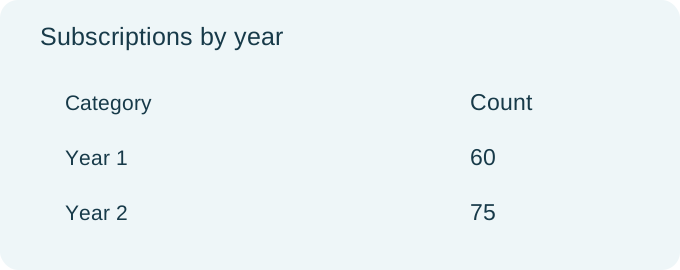
Reading data as relationships Using the subscriptions table, what is the percent increase from Year 1 to Year 2? Dataset 1.
Open full-size diagram ↗ 80 25 15 20 1/4 25 The increase is 15. Use Year 1, the earlier amount, as denominator. 100 × 15/60 = 25%. Compare the other answer choices 15 Returns the count increase without converting to percent.
20 Uses the later count as percent-change base.
80 Reverses the ratio of counts.
1/4 Returns the proportional increase without multiplying by 100.
Reference basis: GRE Quantitative Reasoning overview ; Siyavula Grade 10 mathematics foundation reference . These are original learning questions, not questions reproduced from the references.
QUESTION 07 Arithmetic
Fractions and magnitude What is the exact value of 1/3 + 1/4?
Write a numeric answer.
7/12 Use common denominator 12. The numerator becomes 4 + 3 = 7. The reduced result is 7/12. Reference basis: GRE Quantitative Reasoning overview ; Siyavula Grade 10 mathematics foundation reference . These are original learning questions, not questions reproduced from the references.
QUESTION 08 Algebra
Functions and quadratic structure For f(x) = 1/[(x − 3)(x − 5)], select all listed inputs that are excluded from the domain.
Select all answers that apply.
2 3 4 5 6 3; 5 A denominator must be nonzero. The product becomes zero when either factor becomes zero. The excluded inputs are 3 and 5. Compare the other answer choices 2 At x=2, the denominator is 3, which is nonzero; this input is allowed, not excluded.
4 At x=4, the denominator is -1, which is nonzero; this input is allowed, not excluded.
6 At x=6, the denominator is 3, which is nonzero; this input is allowed, not excluded.
Reference basis: GRE Quantitative Reasoning overview ; Siyavula Grade 10 mathematics foundation reference . These are original learning questions, not questions reproduced from the references.
QUESTION 09 Geometry
Coordinates encode geometry Point P=(3,−5) is reflected across the y-axis to Q. Quantity A: distance OP. Quantity B: distance OQ, where O is the origin.
Quantity A is greater. Quantity B is greater. The two quantities are equal. The relationship cannot be determined. The two quantities are equal. Q = (−3,−5). The squared distances use the same two coordinate squares. Reflection preserves distance to the origin, so the quantities are equal. Compare the other answer choices Quantity A is greater. Treats the negative reflected x-coordinate as reducing distance, but distance uses its square.
Quantity B is greater. Adds the horizontal separation between the reflected points to OQ; the requested lengths start at the origin.
The relationship cannot be determined. Overlooks that the coordinates determine both distances exactly and their squares agree.
Reference basis: GRE Quantitative Reasoning overview . These are original learning questions, not questions reproduced from the references.
QUESTION 10 Data Analysis
Counting and conditional probability A bag contains 5 red and 6 blue beads. Two beads are drawn without replacement. What is the probability both are red?
Write a numeric answer.
2/11 The first-red probability is 5/11. Given a red first draw, the second-red probability is 4/10. Multiply to obtain 2/11. Reference basis: GRE Quantitative Reasoning overview ; Siyavula Grade 10 mathematics foundation reference . These are original learning questions, not questions reproduced from the references.