All examsSAT MathFoundation path
View coverage
FREE ORIGINAL PRACTICE · ANSWERS & EXPLANATIONS

SAT Math Practice Questions & Answers

A focused path through SAT Math. Learn the idea, try it yourself, and keep what you learn.

Read 10 original sample questions with worked explanations before opening the practice studio. These examples introduce selected topics from this SAT Math foundation path.

Free access · No sign-up · No personal progress recorded on this page

What this practice covers

Digital SAT Math foundations expanded to96 distinct task families;400 parameterized practice items, not complete syllabus coverage

Multiple choice and numeric foundation practice; not an official adaptive test.

10 public examples400 question variants in the studio96 task families

Review status: Independent educator review and learner calibration are pending. Use these selected foundation examples alongside the coverage map and current official references.

Check the coverage map and remaining gaps
CHOOSE A STARTING POINT

Topics in this foundation path

The examples below span 4 of 4 learning domains. Counts describe the current catalog, not the exam's official weighting.

TRY A QUESTION. FOLLOW THE REASONING.

Sample questions with answers

Work out your answer first, then compare the explanation. This stable selection uses distinct task families across the available learning domains.

QUESTION 01Algebra

Linear equations

If 3x + 4 = 19, what is the value of x?

  1. 19/3
  2. 23/3
  3. 5
  4. 5/3

Answer: 5

  1. Subtract 4 from both sides: 3x = 15.
  2. Divide both sides by 3: x = 5.
  3. Check: 3(5) + 4 = 19.
Compare the other answer choices
5/3

Divided by the coefficient twice.

19/3

Divided the total by the coefficient before removing the constant.

23/3

Added the constant instead of subtracting it.

Reference basis: Official mathematics skills; Siyavula Grade 10 mathematics. These are original learning questions, not questions reproduced from the references.

QUESTION 03Problem-Solving & Data Analysis

Ratios & units

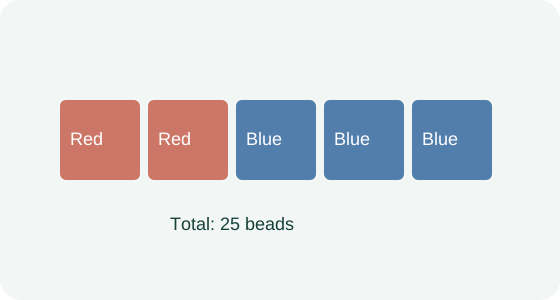
The bar shows the ratio of red to blue beads in a collection of 25 beads. Each box represents an equal share. How many beads are red?

Five equal boxes: two labeled Red and three labeled Blue. Total 25 beads.Open full-size diagram ↗
  1. 25
  2. 5
  3. 10
  4. 15

Answer: 10

  1. There are 2 + 3 = 5 equal ratio parts.
  2. Each part contains 25/5 = 5 beads.
  3. Red beads occupy two parts: 10.
Compare the other answer choices
5

Reported one ratio part instead of two.

15

Reported the blue part instead of the red part.

25

Reported the whole instead of the red part.

Reference basis: Official mathematics skills; Siyavula Grade 10 mathematics. These are original learning questions, not questions reproduced from the references.

QUESTION 05Algebra

Lines & slope

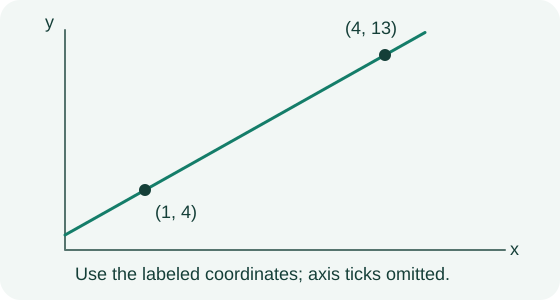
The graph marks two points on a line. What is its slope?

A line passes through the labeled points (1,4) and (4,13). Axes are schematic; use the labels.Open full-size diagram ↗
  1. 13/4
  2. -3
  3. 1/3
  4. 3

Answer: 3

  1. The change in y is 13 − 4 = 9.
  2. The change in x is 4 − 1 = 3.
  3. Slope = 9/3 = 3.
Compare the other answer choices
13/4

Divided one point’s coordinates instead of differences.

1/3

Reversed vertical change and horizontal change.

-3

Reversed only one subtraction order.

Reference basis: Official mathematics skills; Siyavula Grade 10 mathematics; Slope and slope-intercept form. These are original learning questions, not questions reproduced from the references.

QUESTION 07Problem-Solving & Data Analysis

Percent change

What is 20% of 150?

  1. 3/10
  2. 30
  3. 3000
  4. 120

Answer: 30

  1. 20% equals 20/100 = 1/5.
  2. Multiply 150 by 1/5.
  3. The result is 30.
Compare the other answer choices
120

Found the amount remaining after a 20% reduction.

3000

Multiplied by 20 without dividing by 100.

3/10

Converted the percentage twice.

Reference basis: Official mathematics skills; Siyavula Grade 10 mathematics. These are original learning questions, not questions reproduced from the references.

QUESTION 08Geometry & Trigonometry

From areas to volumes

A cylinder has diameter 12 cm and height 8 cm. Its volume is cπ cm³. What is c?

    Write a numeric answer.

    Answer: 288

    1. The radius is half the diameter, 6 cm.
    2. Volume=πr²h=π(6)²(8).
    3. The coefficient is 288; volume has cubic units.

    Reference basis: SAT official Geometry and Trigonometry scope; OpenExamPrep SAT Math archived topic research. These are original learning questions, not questions reproduced from the references.

    QUESTION 09Algebra

    Systems of equations

    If x + y = 9 and x − y = 1, what is x?

    1. 5
    2. 9
    3. 10
    4. 1

    Answer: 5

    1. Add the equations: 2x = 10.
    2. Divide by 2: x = 5.
    3. Then y = 4; substitution verifies both equations.
    Compare the other answer choices
    1

    Used the difference x−y as x.

    9

    Used the total x+y as x.

    10

    Added equations but forgot to divide by 2.

    Reference basis: Official mathematics skills; Siyavula Grade 10 mathematics. These are original learning questions, not questions reproduced from the references.

    QUESTION 10Advanced Math

    Exponential models

    A machine worth $1000 loses 10% of its value each year. What is its modeled value in dollars after 2 years?

      Write a numeric answer.

      Answer: 810

      1. Retaining 90% each year gives a factor of 0.9.
      2. After two years, V = 1000(0.9)².
      3. The value is $810, not the result of subtracting 20% once.

      Reference basis: Official mathematics skills; Siyavula Grade 10 mathematics. These are original learning questions, not questions reproduced from the references.

      BUILD ON WHAT YOU NOTICED

      Turn one question into a learning route

      Start with the lesson linked to an unfamiliar topic, try a focused set in the practice studio, then return to the review cards. Your practice progress stays in this browser.

      Scope, sources and review notes

      Catalog scope record: . This records the saved content mapping, not a guarantee that every external rule is current.

      • Foundation pilot, not complete SAT coverage.
      • Independent educator review pending.
      • Independent educator review pending
      • Editorial difficulty is not calibrated
      • 96 parameterized task families; not400 independent problem designs
      • Expanded foundations, not complete SAT syllabus or official adaptive simulation
      • Caption text reviewed; full audiovisual review not performed

      Check the exam provider's current information for registration, test rules and official preparation materials. The exam guide collects the relevant official references.

      REFERENCEOfficial mathematics skills

      fact_reference

      TEXTBOOKSiyavula Grade 10 mathematics

      CC-BY-4.0 foundation reference; images not republished

      VIDEO SOURCESlope and slope-intercept form

      brief attributed source summary plus independently authored companion; source transcript stays private

      VIDEO SOURCEQuadratic equations by factoring

      brief attributed source summary plus independently authored companion; source transcript stays private

      REFERENCESAT official Geometry and Trigonometry scope

      official syllabus mapping; not source question reproduction

      REFERENCEOpenExamPrep SAT Math archived topic research

      Private archived discovery and critically checked method reference; new lessons/questions are independently authored; no source text redistribution